
The Dodge Viper may be gone, but its outrageous 8.0-liter V10 has found an unexpected new home.
Bristol Cars has brought its bizarre, gull-winged Fighter back to life, completing a car around one of the original unused chassis left behind when the British marque stopped production. The newly finished car made its public debut at Salon Privé at Blenheim Palace in September 2026, marking the first tangible step in Bristol’s latest attempt to return to building cars.
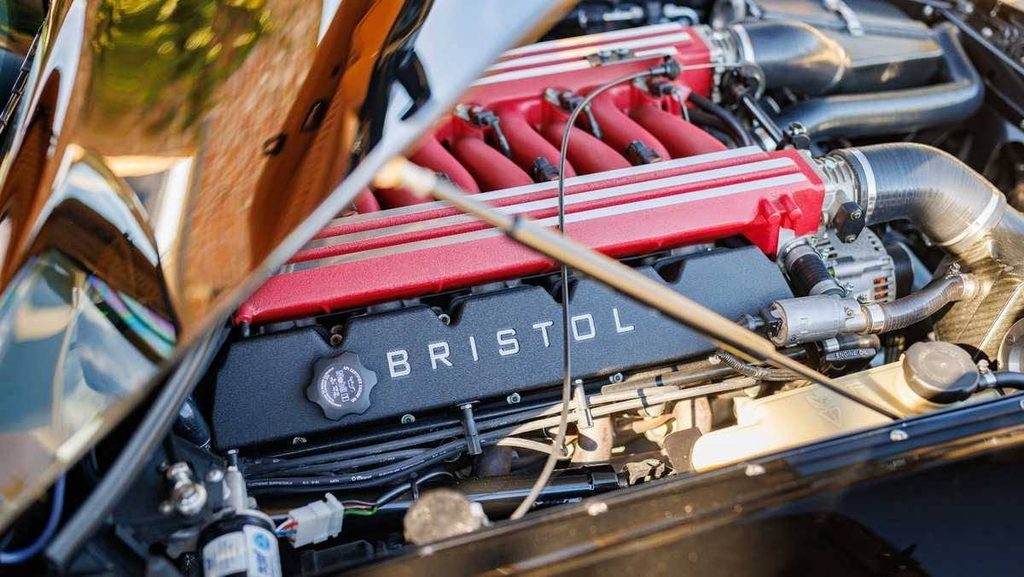
And underneath that long, low British bodywork is the engine that made the original Fighter such a fascinating oddball: the all-aluminum 8.0-liter V10 derived from the Dodge Viper.
The revival is deliberately small. Bristol says five Fighter chassis from the original production program will ultimately be completed, with the first now finished and four remaining examples available to customers. Each will be assembled in the UK using original engineering drawings and components, while buyers can specify details including left- or right-hand drive.
The Bristol Fighter Was Always Different
The Fighter arrived in the early 2000s as Bristol’s answer to the conventional supercar.
It didn’t chase the styling language of Ferrari or Lamborghini, and it certainly wasn’t designed to blend into traffic. Instead, Bristol created a long, aerodynamic two-seat GT with dramatic gull-wing doors and a body influenced by the company’s aviation heritage.
The shape was developed around aerodynamic efficiency, with former Brabham Formula One engineer Max Boxstrom involved in the design. The result was a car that looked unlike almost anything else on the road.
The engine choice was equally unconventional.
Rather than developing a new exotic powerplant, Bristol turned to the enormous V10 developed for the Dodge Viper. The 7,990cc all-aluminum engine gave the Fighter a character that few European supercars could match.
An 8.0-Liter V10 With Viper DNA
In standard specification, the Fighter’s V10 produces 525 bhp. Bristol also offered an uprated version producing around 600 bhp.
Those numbers might not sound extraordinary beside today’s 800- or 1,000-hp supercars, but the Fighter’s combination of displacement, naturally aspirated power and relatively low production volume made it something completely different.
Bristol claimed a top speed of around 210 mph, while the original car could be ordered with a six-speed manual transmission. The newly completed example displayed at Salon Privé retains that old-school character rather than trying to turn the Fighter into a modern hybridized supercar.
That matters because the V10 is increasingly becoming an endangered species in the supercar world.
The original Dodge Viper is no longer in production, and modern manufacturers have largely moved toward smaller turbocharged engines, electrification or hybrid powertrains. That makes a newly completed 8.0-liter naturally aspirated V10-powered car an increasingly unusual proposition.
Bristol Found a Way to Finish What It Started
The most interesting part of the 2026 Fighter isn’t simply that Bristol decided to revive an old model.
The company actually had the hardware to do it.
Five unused Fighter chassis remained from the original production program, along with engineering drawings and other components. Rather than recreate the car from scratch, Bristol is using those surviving pieces to finish the unfinished production run.
The first completed example is finished in black with a tan interior and was presented at Salon Privé as part of the marque’s 80th-anniversary celebrations.
The remaining four cars will be built individually for customers. Bristol says buyers will have the opportunity to specify their cars, including the choice between right- and left-hand drive.
That makes the new Fighters less like a conventional new-car production run and more like the completion of a chapter that was interrupted more than a decade ago.
Bristol’s Strange Road to the Viper V10
The Fighter makes more sense when you understand Bristol’s history.
The company traces its automotive roots to the Bristol Aeroplane Company, with its car division producing the Bristol 400 in 1946. Early Bristol automobiles were heavily influenced by BMW engineering, and the company subsequently developed a reputation for unusual, low-volume luxury cars.
Later Bristol models moved toward Chrysler V8 power.
The Fighter represented a dramatic departure from those traditional grand tourers. It was lower, wider and far more overtly performance-focused, while retaining the company’s preference for understated individuality.
The result was a British supercar powered by an American V10.
It was a strange combination, but that’s exactly what made the Fighter memorable.
The Fighter Is Back, But Bristol Isn’t Pretending It’s Business as Usual
Bristol Cars entered administration in 2011, bringing the original Fighter program to an end. A later attempt to revive the brand produced the BMW V8-powered Bristol Bullet concept in 2016, but that car never entered production.
The current revival is taking a different approach.
Owner and director Paul King is leading the project, with Richard Hackett serving as chairman. Hackett previously worked closely with longtime Bristol boss Tony Crook during the original Fighter era, giving the new operation a direct connection to the company’s past.
Production of the five Fighters will take place in Britain with an unnamed specialist manufacturing partner experienced in low-volume engineering and craftsmanship.
Bristol describes the Fighter program as the beginning of its return rather than the end goal.
What comes next remains unclear.
Can Americans Actually Buy One?
For U.S. enthusiasts, there is another interesting wrinkle.
Bristol says the revived Fighters can be imported under the federal Show or Display provision. NHTSA’s rules allow qualifying vehicles of unusual historical or technological significance to be imported under that exemption, although their use on U.S. roads is limited to 2,500 miles per year.
That doesn’t make the Fighter a conventional daily-driver purchase in America. But this isn’t really a conventional car.
The combination of an original unused chassis, extremely limited production, British hand assembly and an 8.0-liter V10 gives the revived Fighter a very specific appeal to collectors.
Pricing for the remaining cars has not been publicly announced and is being handled directly with prospective buyers.
One of the Weirdest V10 Comebacks Yet
There are faster cars. There are more technologically advanced cars. There are certainly more powerful cars.
But very few new cars in 2026 can claim to combine a surviving early-2000s chassis, gull-wing doors, British low-volume craftsmanship and an 8.0-liter Dodge Viper-derived V10.
That’s what makes the Bristol Fighter revival so unusual.
Bristol isn’t resurrecting the model with a downsized turbocharged engine or an electric drivetrain. It’s finishing the project almost where it left off.
The first car is already complete. Four more chassis remain.
And if Bristol succeeds in putting all five back on the road, the Fighter will have accomplished something remarkably rare: disappearing from production, surviving as a forgotten piece of automotive history, and then returning years later with the same giant V10 that made it famous in the first place.